The whole company.
Your own multi‑geo cluster.
Mail, chat, phone, calendar, files, and your own directory — one login, and the keys stay with you. You own it. You don't rent it.
Mail, files, chat, a phone system, and your own directory — hosted from $4.50 a mailbox a month, or buy the licence and run it yourself. See the plans →
Your whole company, one login.
Mail, chat, phone, calendar, files, and your people — all behind one login, on a cluster your company owns. Two locations, not one box you hope stays up.
The keys are yours.
No vendor holds them — not even us. Seal your mail and the server itself can't read it.
Host it, or we host it.
Run it on your own machines, or let us run the cluster and pay by the mailbox. Either way the licence, the data and the keys are yours. See the plans →
We set it up with you.
The domain, the cluster, the DNS — we do it together. No domain yet? We help you get one.
The name
No domain yet? We register one with you at a provider like Porkbun, in your own account. A name you already own stays right where it is — any registrar works.
The cluster
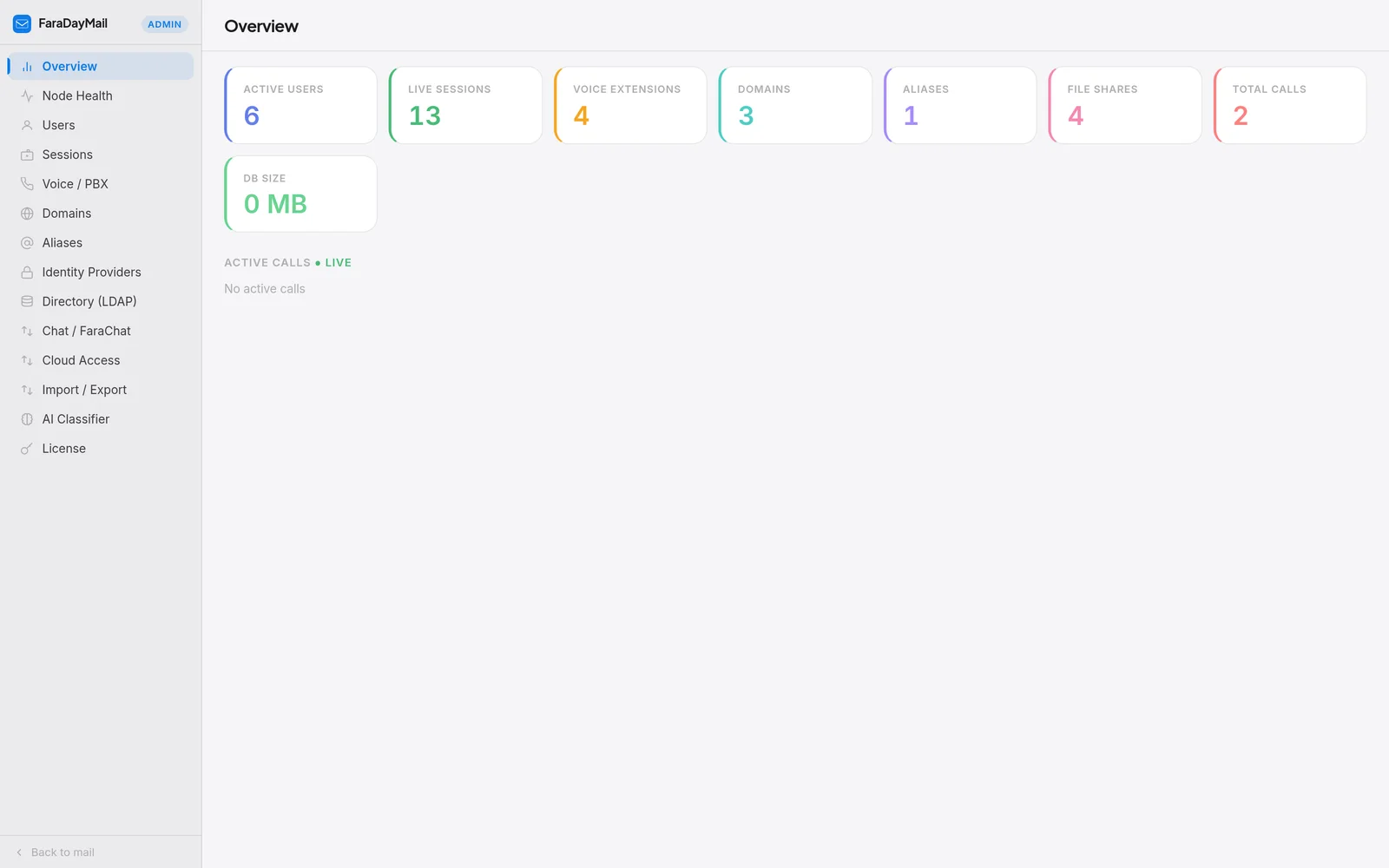
Your own multi-geo cluster, on whichever hosts you choose. Two nodes keep a full copy of the mail; a third lets it fail over on its own. A household runs on one box, and a license runs on any machines you like.
The DNS
Your registrar keeps the name; a DNS host answers it. We write every mail record with you — whichever provider you use.
You open one app.
Your inbox is the front door. Everything else runs behind the same login.
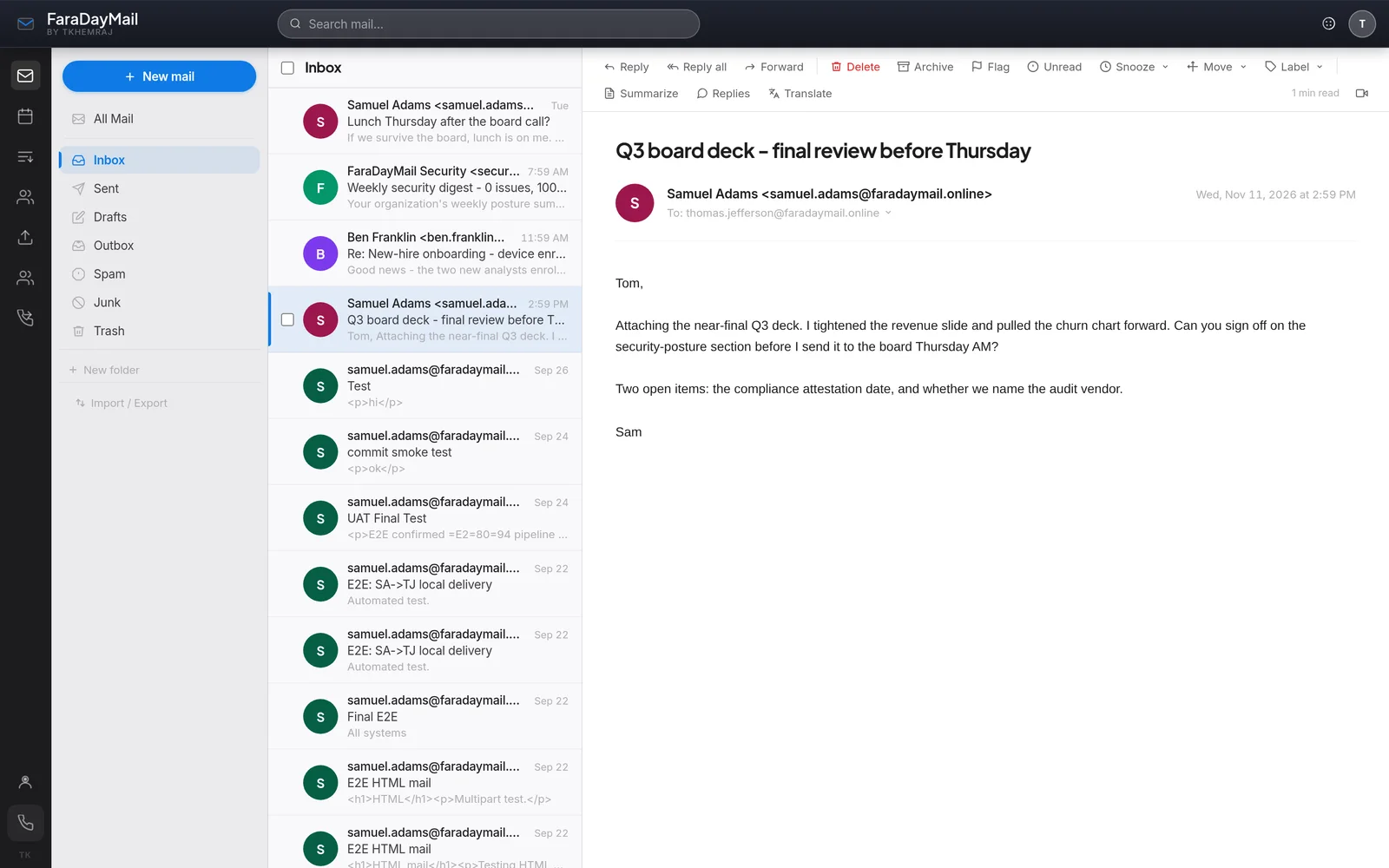
The inbox above is the real thing — threads, rules, a vacation reply. And it still works in the mail apps your people already use.
Chat
Rooms for everyone with a mailbox here. It stays inside the company until you choose to bridge it to Teams, Slack or Discord.
Phone
Everyone gets an extension and a phone in the browser. Add real numbers and a front-desk queue when you need them.
Calendar
Your calendar, on your own cluster — and it opens in Apple Calendar, Thunderbird and Outlook.
Files
Storage the size of each mailbox, on your cluster, shared with whoever you name.
The directory
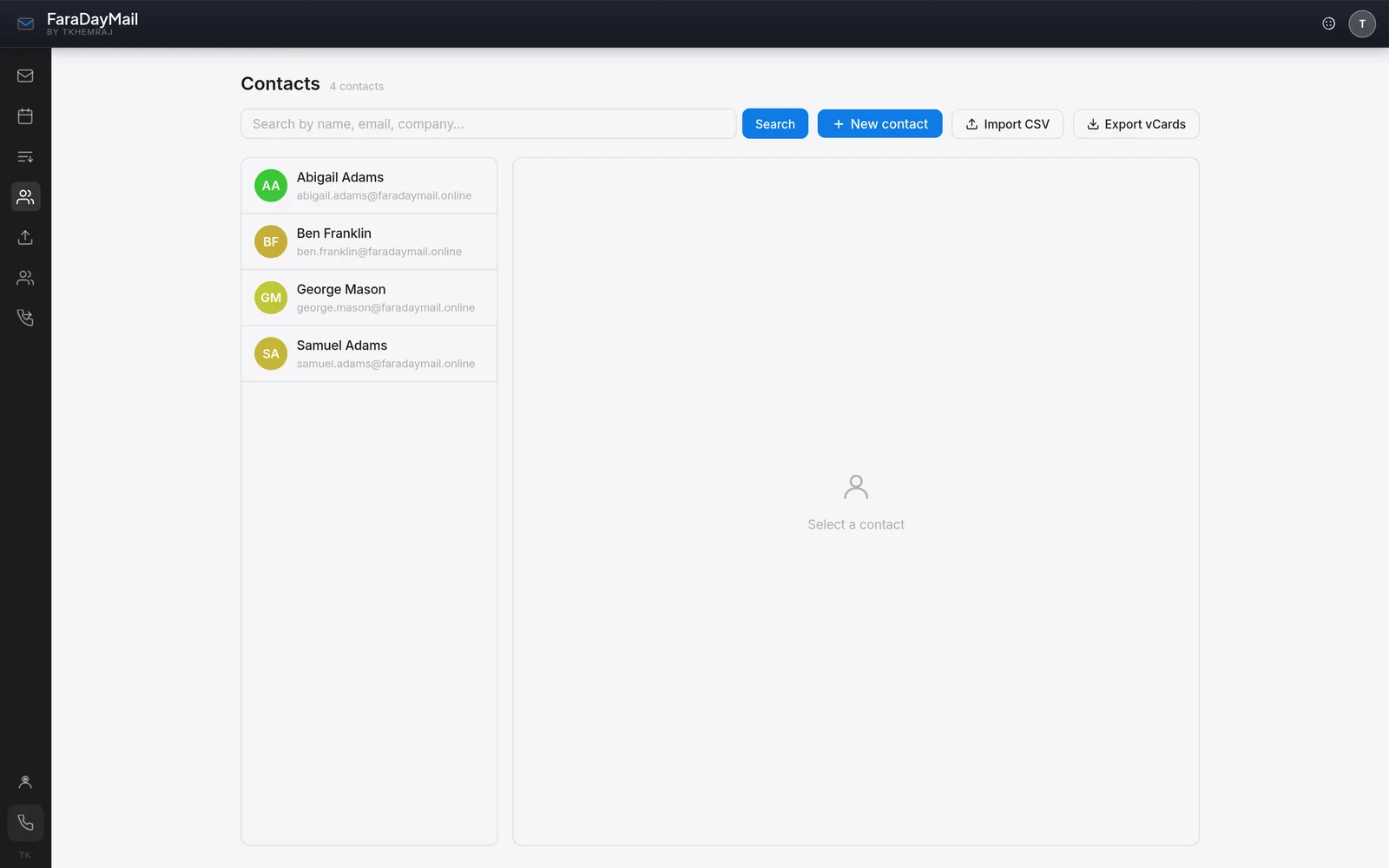
One identity per person. Windows and Linux machines join it, passkeys included — and a mailbox that's already here is never imported twice.
Here's how it actually works.
The service is written in Rust. You pick the trust model at install: a managed mailbox, or sealed mail, where the keys are made in the browser and the server only stores ciphertext.
Sealed mail
In zero-access mode each person holds the key in the browser, under their password. The database, every replica, and every backup store ciphertext the server cannot open.
The password is proven, not sent
Sign-in proves the password. The server keeps a verifier it cannot turn back into that password, and it proves itself to the browser. A one-time code and a passkey sit on the same account.
Recovery you hold
A recovery code, shown once, or a security key. Register two, so losing one is not a lockout. A strict mode has no second way in. The password is the only key.
A record you can check
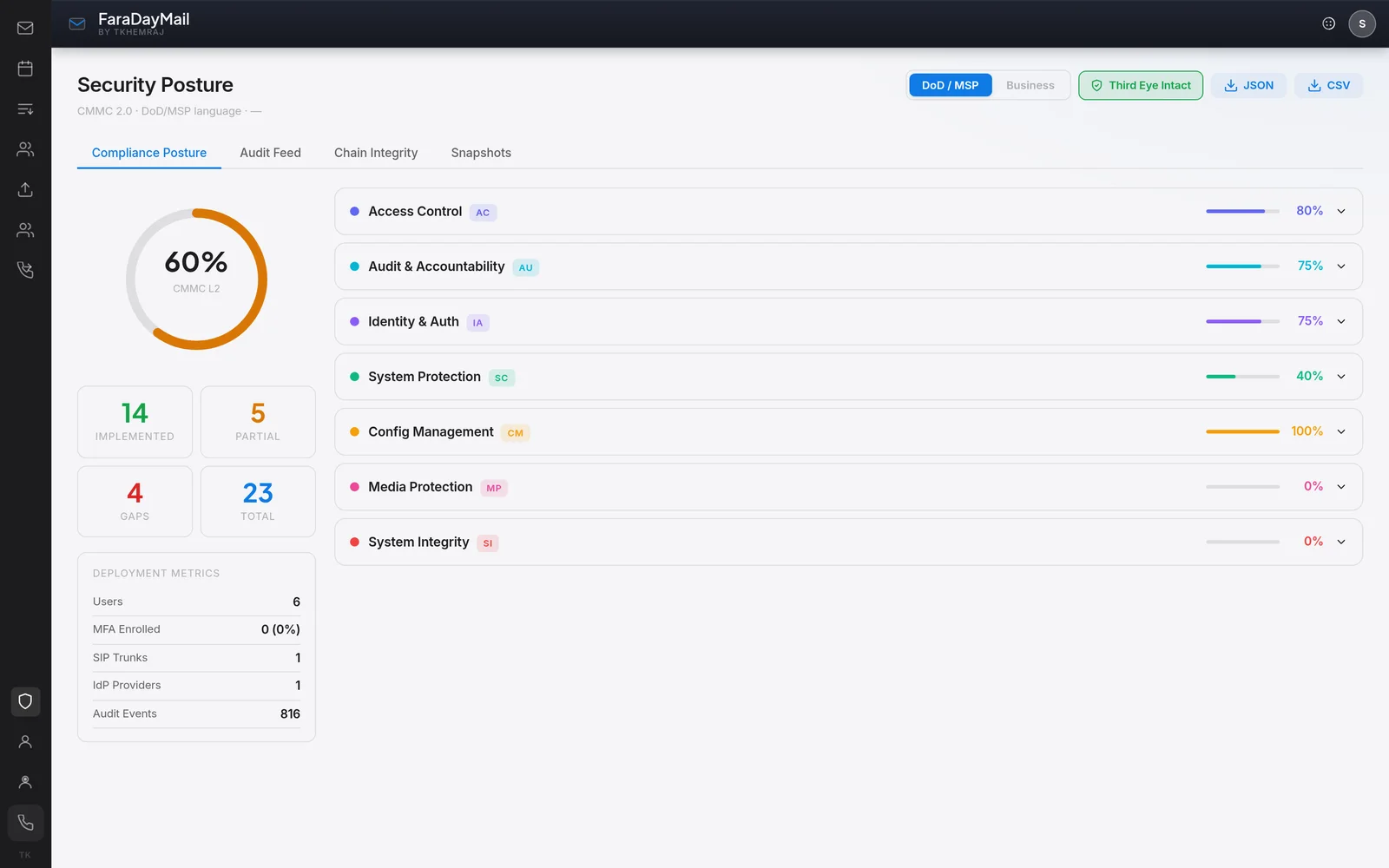
Each security event is chained to the one before it. The posture score reads that record against the compliance control set and leaves a gap as a gap. It is not a certificate.
Mail that arrives clean
Spam and malware are stopped on the way in. DKIM, SPF, and TLS are on from the install.
Self-healing cluster
Three nodes is the smallest cluster that fails over on its own. Quorum-gated promotion, measured at 22–24 seconds. Mail replicates to one peer.
The pieces, if you want them
Written in Rust. Mail moves through Postfix and Dovecot. Rspamd and ClamAV stop spam and malware on the way in. DKIM, SPF, and TLS are on from the install. Chat is Synapse, a Matrix homeserver you run, and federation stays off until you turn it on. The phone is Asterisk, with a browser phone, extensions, and queues. The directory is Samba Active Directory. Calendars open in Apple Calendar, Thunderbird, and Outlook.
Sign-in proves the password. The server keeps a verifier it cannot turn back into that password, and it proves itself to the browser. Passkeys sit on the same account. Translation stays on the server unless you allow it to leave. In sealed mode the database, every replica, and every backup hold ciphertext the server cannot open. The posture score reads a hash-chained record against the compliance control set. A control that was not observed is not marked done. It is a score, not a certificate.
You don't have to be a sysadmin.
Self-hosting a whole company suite used to mean a weekend of config files. FaraData installs with three questions, and after that there's one command to remember.
One command to stand it up. One word to run it.
The installer asks for your domain, an admin email and a password, checks the machine is ready in plain words, and does the rest. From then on it's fdm — plain verbs, not man pages.
- Add people, take backups, update safely —
fdm user add,fdm backup,fdm update. Updates back up the database first, health-check, and roll back on their own if anything breaks. - It tells you when something's wrong. The box watches its own health and alerts you when it changes — it doesn't wait for you to notice.
- Stuck? One safe bundle for support.
fdm supportpackages the logs with every password and key stripped out — safe to send.
$ sudo bash easy-install.sh
  Domain?        acme.com
  Admin email?   [email protected]
  Checking this box…  ✓ ready
  ✓ FaraData is up at https://acme.com

$ fdm status
  ✓ API: responding
  ✓ faradaymail-rust: running
  ✓ Mail queue: 0 deferred
  ✓ TLS cert: valid for 89 days

$ fdm user add [email protected]
  ✓ created [email protected]

$ fdm backup setup
  ✓ nightly backups scheduled
Cheaper than Microsoft — and you keep the keys.
Twenty-five people, each with a 5 GB mailbox and 5 GB of files, for one year.
Microsoft 365 Business Basic
- Per seat, forever — the bill grows with every hire
- Microsoft holds the keys and the tenancy
- Renews higher
FaraData, hosted
- We run the cluster; you hold the keys
- Or self-host the licence for $600/yr, on machines you choose
- No per-seat lock-in
Microsoft 365 Business Basic, US list price, annual, $7/user/mo. Self-hosting is 25 × $2.00 = $600 for the year and replaces the hosted bill — it is not added on top. No SLA on either.
Three ways to run it.
Host it yourself, or let us run the cluster. It is the same product either way, and your data and keys stay yours. No SLA on any plan.
It is all included — self-manage at no extra charge. Want us to run your devices, voice or the whole stack? Optional managed add-ons, priced separately. Move mail in from Microsoft 365, Gmail or Yahoo and out again anytime; documents, sheets and slides are coming.
- The whole suite, on your own box
- Family safeguards: a child's mail, files and calls stay in the house until a parent allows them out
- Self-serve docs — no support plan
- Run it on any machines you own
- Updates and support tickets included
- $2.00/user from 25 people, down to $1.00. Best to ~50; past 100, let us host it
- Two nodes you promote, or a third that heals itself in ~22s
- Priced by mailbox size — a mailbox plus the same again in files
- One bill — the licence is already in it
| Plan | Who it is for | You pay |
|---|---|---|
| Evaluation · unlicensed | Up to 5 people, trying it out (no key) | Free |
| Community Edition · self-host | Up to 12 · non-commercial: family, non-production, non-profit | $25 once · lifetime |
| Supported · self-host | Your servers, 1–24 people | $2.50 /user/mo |
| Supported · self-host | 25–99 people · falls to $1.00 by 1,000 | $2.00 /user/mo |
| Hosted · 2 nodes | 5 GB mailbox + 5 GB files · you promote the survivor | $4.50 /mo |
| Hosted · 2 nodes | 25 GB mailbox + 25 GB files | $22.50 /mo |
| Hosted · 2 nodes | 100 GB mailbox + 100 GB files · company from $36/mo | $90 /mo |
| Hosted · 3+ nodes | 5 GB + 5 GB · cluster heals itself | $6.75 /mo |
| Hosted · 3+ nodes | 25 GB + 25 GB | $33.75 /mo |
| Hosted · 3+ nodes | 100 GB + 100 GB · company from $54/mo | $135 /mo |
| Hosted · Community | One box, up to 12, no failover | $25 /mo |
| Compliance Edition · regulated | Your data on your own cluster · immutable identity ledger · crosswalked to NIST 800-171 / SOC 2 / HIPAA / PCI / GDPR / CMMC 2.0 | By contract |
Per-user pricing is flat at the tier — 40 people pay 40 × $2.00, it does not stack. Hosted is a mailbox plus file storage the same size, billed once for the whole company, licence included. You bring a domain and we set up the DNS with you — Porkbun, or whoever you already use. The licence is caveat emptor: you own the data and the keys.
NIST-grade security — whether or not you answer to an auditor.
Most platforms sell compliance as a paid add-on for the regulated few. We build the controls in for everyone, then prove them. If you already answer to a framework, FaraData meets it and hands your assessor evidence. If you’ve never had one, you inherit a security baseline built on NIST SP 800-171 the day you switch it on.
We meet it, and prove it.
NIST 800-171, SOC 2, HIPAA, ISO 27001, CMMC 2.0, a cyber-insurance questionnaire — they ask the same core questions: who has access, how they prove who they are, and whether your audit trail can be trusted. FaraData answers them in code: multi-factor and replay-resistant security keys, least-privilege role changes, full account lifecycle, and a tamper-evident identity ledger your assessor can verify offline — against Okta, Entra, Google Workspace and AWS alike.
Then FaraData is your framework.
No compliance team, no policy binder, no idea where to start — that’s most companies, and it’s not a failing. Instead of handing you a checklist, we hand you the controls already switched on: the same NIST-800-171-aligned defaults the regulated run on. Multi-factor sign-in, least privilege, zero-access encryption, and a verifiable record of every identity change — a credible security posture from day one that can grow into a formal certification if you ever need it.
We don’t sell you a certificate — no vendor can. We give you the access controls, the encryption and the tamper-evident evidence a certification is built on, and keep the data and the keys on hardware you own. The Compliance Edition below is the same suite with the audit controls your frameworks ask for enforced in code and crosswalked to the regimes you answer to.
FaraData Compliance Edition
Hold your data on a cluster you own, and hand any assessor a tamper-evident record of who touched identity and access — not a trust-me spreadsheet. The same suite, with the audit controls your frameworks actually ask for enforced in code and crosswalked to the regimes you answer to: NIST 800-171, SOC 2, HIPAA, PCI DSS, GDPR — and CMMC 2.0.
- Immutable identity ledgerEvery account, role, credential and login is sealed into a SHA-256 hash chain. Alter, delete or reorder one entry and verification names the broken record. AU.2.041 · AU.2.042.
- Least privilege, every change tracedRole and privilege edits evidenced against AC.2.007; multi-factor and replay-resistant security keys against IA.3.083 · IA.3.084.
- Auditor export, offline-verifiableOne pull returns the whole chain plus the parameters to recompute it independently — and the data and keys never leave your box.
GET /api/audit/identity-ledger
↳ 9f3c…a1 ✓ verified
#119 auth.login_success · user:7 · 10.0.0.9
↳ b72e…04 ✓ verified
Built by someone who's run the migrations, not just sold them.
I've built payment systems, and some of the largest Microsoft identity rollouts on the planet. I've spent a career learning exactly how data leaves an organization — the vendor, the integration, the default nobody thought to question — and FaraData is that knowledge turned around: your data on hardware you own, the keys never leaving your hands.
Then there's Glustic: self-hosted, end-to-end encrypted messaging that runs off-grid over LoRa, on radio hardware I build by hand — I've got the flux burns to prove it. It works, at real range, and it's patent pending. I'm now looking at using LoRaWAN to help with Type 1 diabetes management.
“I spent years moving millions of identities onto infrastructure other companies controlled. FaraData is the version where that never happens again — your data, your hardware, your keys.”— Tarique Khemraj, maker of FaraData
The people behind it have worked where mistakes are expensive.
We understand mail, mailflow, security, and the way real attacks actually land — not the brochure version. Some of us carried production inside towers where a wrong answer has a half-life.
High-consequence pedigree
Members of this team have run systems for NASA, the U.S. Nuclear Regulatory Commission, and other high-trust, high-consequence operations. We build to the standard those places demand, because that's where we learned it.
We know how data leaves
Mail and mailflow are our home ground, and so are the attacks aimed at them. We've done the extraction and we've stopped it — the defense is just the attack, understood first.
We want you to win
We want your success, and we want your business — or your family — to take back control of your own estate. Keys included. That's the whole point of this.
Sign in
Already running FaraData? Sign in to your deployment.
Just exploring? Email me or open the hosted app.
Talk to the maker
Questions, a quote, or a migration you want help scoping — send a line and I'll reply, usually the same day.
[email protected] or [email protected]
It's yours.
Mail, chat, phone, calendar, files, and your directory. Five people, free.
Get started free →