Identity Ledger
A tamper-evident, append-only record of who touched identity and access — sealed in a hash chain, independently verifiable by your C3PAO assessor, and mapped to the NIST SP 800-171 / CMMC 2.0 controls that require it. Run it inside the FaraData suite, or standalone over the directory you already have.
Its own product · sold by contract · reports and acts on-premise · your data and keys never leave your box.
Two ways to run it.
The Identity Ledger stands on its own. Bolt it onto the identity estate you already operate, or turn it on natively inside the FaraData family — same tamper-evident chain either way.
Over the directory you already run
Point it at your existing identity estate. It ingests account lifecycle and authentication events over SCIM 2.0 and OIDC, seals each one into the chain, and reports and acts on-premise. No rip-and-replace, no new source of truth.
Air-gappable, self-hosted, one organisation per license.
Native across the whole suite
Inside FaraData, every identity event from mail, chat, voice and the built-in directory flows straight into the ledger — zero integration. The audit trail is complete from day one because it is a projection of the suite's own sealed event log.
Same endpoint, same export, same assessor-ready bundle.
Your identities don't have to move.
The ledger is source-agnostic: it seals identity events from any directory that can provision over SCIM 2.0 or authenticate over OIDC — the open standards Entra, Google and the major IdPs already speak. Each account create, role change, disable and deprovision becomes one sealed, attributed link.
On-premise Active Directory LDAP / AD
Runs fully on-prem or air-gapped, tracking AD/LDAP-sourced identities — or stand up FaraData's own hardened AD domain controller and be your own directory. The box, the keys and the ledger stay inside your boundary.
Any Entra forest SCIM 2.0 + OIDC
Configure SCIM user provisioning in the Entra portal and SSO over OIDC. Every create, disable and deprovision Entra pushes is sealed into the identity ledger — the record your assessor verifies independent of Microsoft.
Google directory services OIDC + SCIM
Google Workspace / Cloud Identity as the IdP: OIDC single sign-on and SCIM provisioning. User lifecycle from Google lands in the same tamper-evident chain, control-mapped the same way.
Any SCIM 2.0 IdP RFC 7643 / 7644
Okta, Ping Identity, OneLogin — anything that speaks SCIM 2.0 provisions straight in. The ledger classifies the events to real NIST 800-171 / CMMC practice IDs regardless of which IdP emitted them.
Pull the audit trail, not just provisioning.
Beyond live SCIM provisioning, the ledger ingests each platform's own audit log and runs every event through one classifier to real NIST 800-171 / CMMC practice IDs. Hand it the provider's audit records — your export or pull — and each entry is sealed into the chain, tagged with its source. Anything it can't yet map precisely is surfaced for review, never silently dropped.
Microsoft Entra Graph audit + sign-ins
directoryAudits and signIns normalised and sealed — the audit-pull companion to live SCIM provisioning.
Google Workspace Reports API
Admin and login activities from the Reports API, control-mapped into the same tamper-evident chain.
Okta System Log
The /api/v1/logs System Log, with sign-in success vs failure read correctly from outcome.result.
AWS CloudTrail
IAM, IAM Identity Center and Cognito identity events lifted straight out of CloudTrail.
What's proven: ingest — you supply the provider's audit JSON (an export or your own pull) and it is normalised, classified and sealed — is verified end-to-end. Direct live-tenant pulls are built and ready but await your tenant credentials. Integration uses each platform's own standard APIs (SCIM 2.0, OIDC, and the providers' audit APIs); FaraData is not affiliated with or endorsed by Microsoft, Google, Okta or Amazon Web Services, and your directory data never leaves your boundary.
Evidence to show, and lifecycle to enforce.
Two jobs, one sealed record behind both.
- One endpoint exports the whole chain as a self-verifying evidence bundle.
- Every entry is pre-mapped to the NIST SP 800-171 / CMMC 2.0 practice it satisfies.
- Your C3PAO recomputes the chain offline — no trust in our binary required.
- Provision, deactivate and deprovision accounts over SCIM as your IdP signals them.
- Deactivation is a soft-delete that preserves the trail — nothing is erased.
- Every action it takes is itself sealed into the ledger as the next link.
Every identity action, sealed in order.
Accounts, roles, credentials, logins, MFA — the events a defense auditor cares about — recorded into one chain that can't be quietly edited after the fact.
It records
Account created, role changed, credential reset, login, failed login, MFA, security-key enrolment — each written once, with a timestamp and the identity that did it.
It verifies
Each entry is sealed with a SHA-256 hash of its contents and the previous entry's hash. Alter, delete or reorder a single record and verification fails — and names the exact sequence number that broke.
It exports
One pull returns the whole chain plus the parameters to recompute it offline — the evidence bundle your assessor can verify themselves, without trusting us.
The chain is the proof.
No one has to trust a log file. The math does the work.
Because each record binds the one before it, you cannot remove a login from the middle, change who got promoted to admin, or slip in a back-dated entry without breaking every hash after it. The ledger is a verified projection of FaraData's sealed event log, which is itself HMAC-sealed at the head so even truncating the tail is detectable — the integrity intent behind NIST 800-171's audit-protection requirement.
Mapped to real controls, not marketing.
Each kind of event is tagged with the NIST 800-171 / CMMC 2.0 practice it evidences, straight from the control set in the product.
| Event in the ledger | Mapped control | What the control asks |
|---|---|---|
| Account provisioned / modified / removed | IA.1.076 | Identify every information-system user, process and device. |
| Role / privilege changed | AC.2.007 | Employ the principle of least privilege. |
| Login success · credential changed | IA.1.077AU.2.041 | Authenticate users before access; uniquely trace each user's actions. |
| Failed login | AC.1.001AU.2.042 | Limit access to authorized users; create and retain audit logs. |
| MFA challenge / verified | IA.3.083 | Use multi-factor authentication for local and network access. |
| Security key enrolled / removed | IA.3.084 | Employ replay-resistant authentication mechanisms. |
| Every entry, always | AU.2.041AU.2.042 | Individual actions uniquely traced, and the record retained tamper-evident. |
Ironvale Defense: a CUI program, audited.
A fictional defense contractor at the GCC High trust level (the .example domain makes clear it isn't a real org). An engineer is onboarded onto a CUI program, given a FIPS security key, escalated to the cui-engineering role, logs in with MFA, an intrusion attempt bounces off another account, and the engineer is offboarded. Below is exactly what the assessor pulls — and what happens when someone tries to doctor it.
Captured from cargo test against the shipping ledger — every hash, count and verdict is real.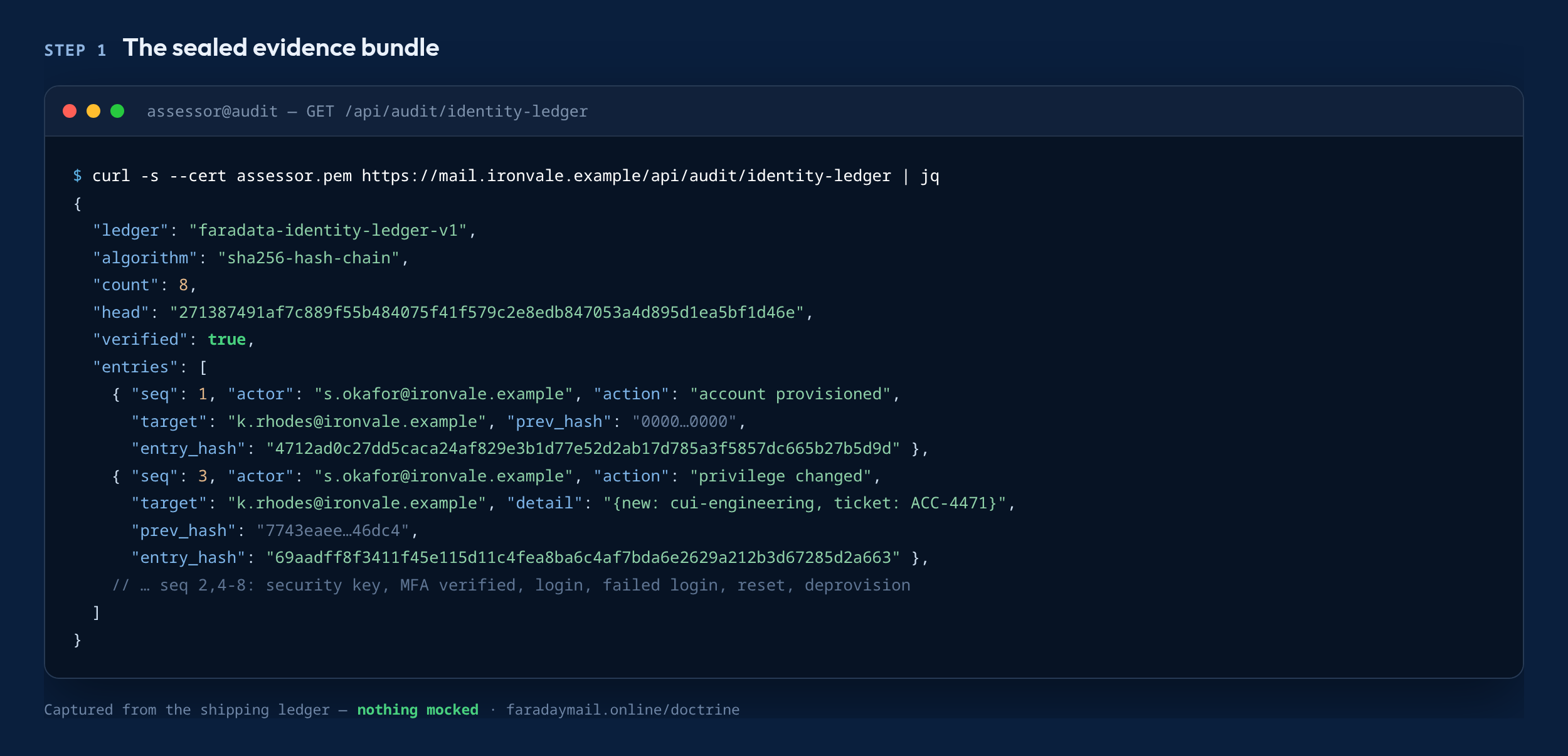 1 · The sealed evidence bundle
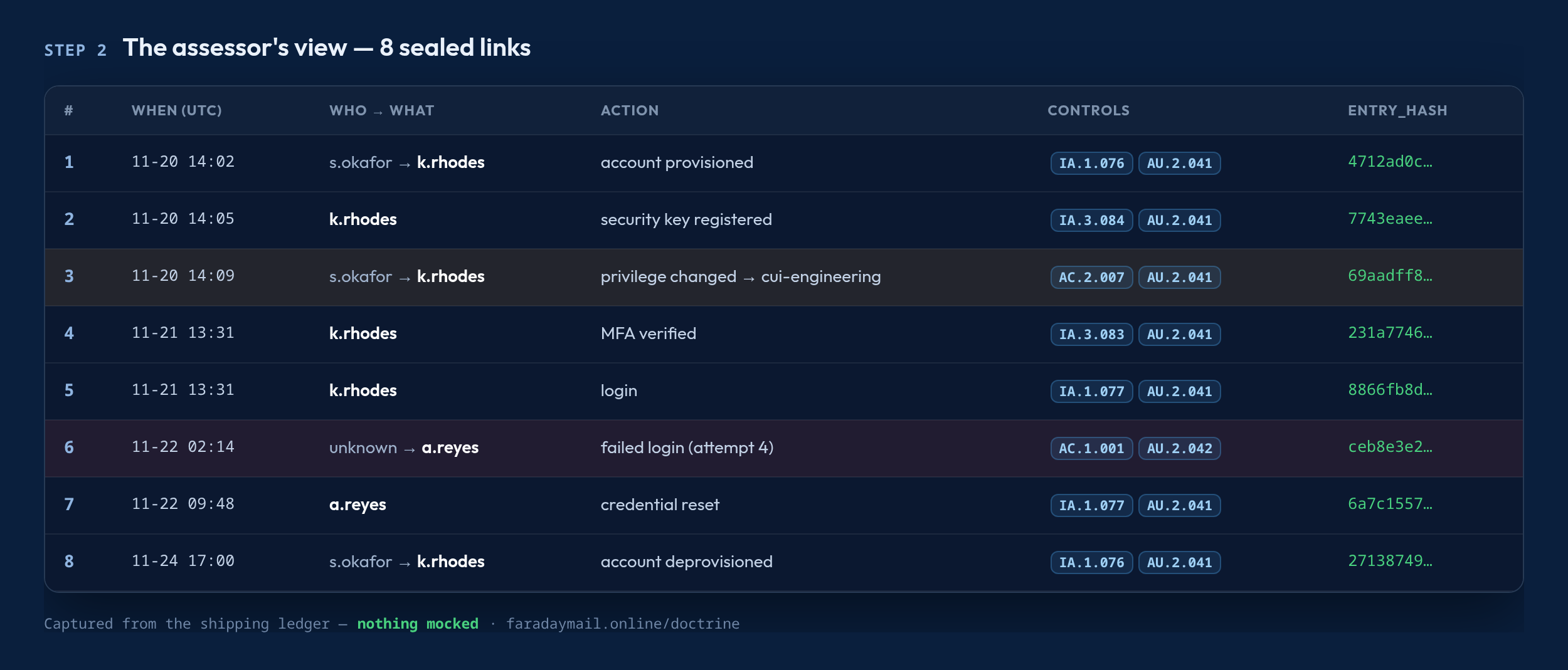 2 · The assessor's view — 8 sealed links
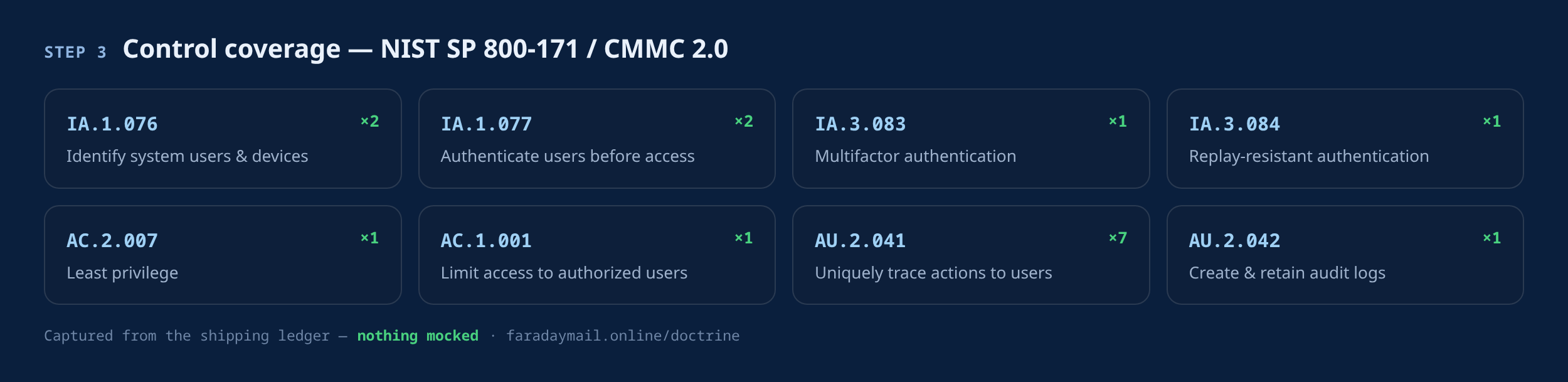 3 · Control coverage
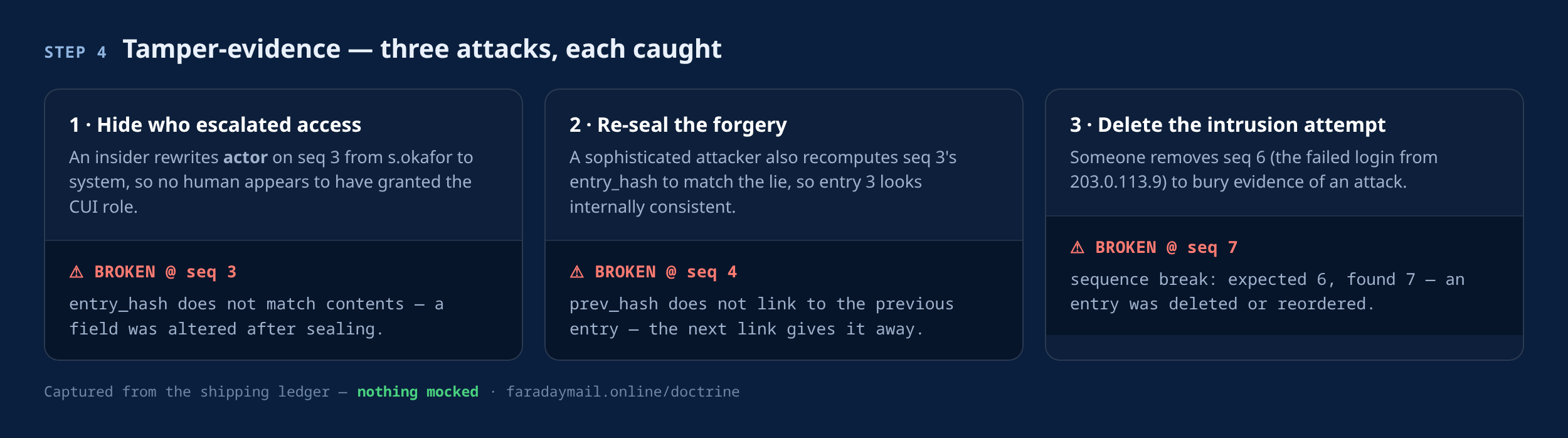 4 · Tamper-evidence
There is no edit that survives. To change one entry you must re-hash it; to make that re-hash link you must re-hash the next; and so on to the head — whose value the assessor already wrote down (271387…1d46e). That is the difference between proof you hold and proof you lease.
The whole chain, on demand.
An admin pulls the ledger; the response verifies the source chain first, then returns the identity subset re-chained and control-tagged.
GCC High rents you compliance. We let you hold it.
GCC High is a real answer to CUI — a sovereign, screened Microsoft tenant. But the keys, the audit log and the attestation all live with the provider. When an assessor asks "prove no one tampered with who had access," the answer is "Microsoft says so." A defense contractor should be able to prove it themselves.
Proof you lease
- The provider holds the keys and the audit log; you get a dashboard and their word.
- Tamper-evidence is a policy promise, not something you can recompute on demand.
- Per-seat pricing scales against you, and leaving means re-platforming.
Proof you hold
- Zero-access by construction — keys are sealed under the user, never leave the box.
- A tamper-evident chain your assessor recomputes offline — it names the broken link.
- One license, one organisation, sold by contract to your CUI scope — no per-seat ratchet.
The ledger is downstream of a discipline.
Four rules decide what ships — and the fifth is how the product tracks a moving regulation without you re-platforming.
Prove, don't claim.
Every capability is graded: proven by a test and a live probe, or it isn't claimed. The audit below is captured from the real code, not a mockup.
Zero-access, or it isn't yours.
Data is sealed under keys derived from the user — a P-256 key under an Argon2id KEK, with FIDO/PRF and recovery-code unlock. The operator, and we, cannot read the plaintext.
One source of truth, self-checking.
The identity ledger is a verified projection of the already-sealed event store, not a second table you'd have to trust. It re-verifies on every pull.
Written to be verified, in Rust.
Sealing, chaining and verification are pure and independently tested — 589 tests, 15 on the ledger's tamper-evidence. An assessor recomputes the chain from the bundle without trusting our binary.
The control set is versioned data, and coverage fails closed.
CMMC and NIST SP 800-171 move — 800-171 went rev 2 → rev 3, and CMMC 2.0 assessment is phasing in. So the controls aren't baked into prose: they live as a versioned data table in the product (CMMC_CONTROLS), and the ledger maps each event to those real practice IDs programmatically. When the practice set changes, the mapping updates with it and ships through the Compliance edition's priority + assessor support — your evidence stays aligned to the current IDs without a migration.
And coverage can't quietly regress: the ledger format is versioned (faradata-identity-ledger-v1) and new identity events fail closed — a newly added account, auth, MFA or directory-sync event is captured into the chain by default rather than silently dropped. The product grows; the audit trail only ever gets more complete.
A feature proves a point. A product carries a program.
A defense contractor doesn't buy a hash chain — they buy the ability to run their program on infrastructure they own and pass an assessment on it. That's an edition, not a demo.
The whole stack, one edition
Mail, chat, voice, calendar, files and your own Active Directory. The Compliance Edition turns the identity ledger on and binds the license to your CUI scope and seat count.
Sold by contract, on purpose
No self-serve checkout. A signed key carries your scope, so procurement, the DFARS flow-downs and the assessor all point at one artifact. Priced to the program, not per mailbox.
Assessor-ready out of the box
One endpoint exports the evidence bundle, pre-mapped to the NIST SP 800-171 / CMMC 2.0 practices it satisfies.
Proving your controls to an auditor?
The Identity Ledger ships in the FaraData Compliance Edition — the whole suite on infrastructure you own, with the audit trail your assessor can verify for themselves. Sold by contract so the key carries your compliance scope and seat count.
Talk to us about compliance